

By Maddie Gold
September 11, 2024
Listen to this post.
After the July 4 shooting in Highland Park, Illinois, in 2022, my parish quickly sprang into action—praying alongside our neighbors, community organizing around gun reform, and delving into the pain, fear, and grief that linger years after the events of trauma occur. Many of our parishioners attended the parade where a gunman killed seven people and injured 48 more. I was in my first year of full-time ministry, and I had no idea how I could help.
I had no idea how I could help
I’m a good student. I feel comfortable when I can imagine the next steps. When a shooting interrupted the daily grind of ministry, I was caught up in a cycle of feeling unfit and inexperienced. Within hours of the shooting, my colleagues and I were sent in all directions. There are the details of the week—the prayer vigil, the shaky phone calls to parishioners waiting for them to pick up, breathing prayers that they were some of the lucky ones, finding folding chairs to welcome people into an overflowing sanctuary to heal together, the desperate hugs shared while holding onto each other, feeling what could have been lost, a sense of security dissolving as the yellow caution tape reminded us of our lack of control, our lack of freedom.
Unprepared
I hadn’t planned to go into ministry. If I had my druthers, I would have gotten into a PhD program immediately after completing my MDiv in 2020. When I was on the job search, I wanted to find a “normal” job—take some time away from God-work, get an office job with two computer screens, respond to emails, stop thinking so much. Because I graduated into the pandemic, the job market was difficult. After applying to over 60 jobs, I started to consider church work. When I did, a perfect job appeared on the North Shore of Chicago. Parish ministry was new to me, but I was surprised to find that the last seven years of higher education had indeed seeped into my being. Curveballs appeared, but there were few things I felt ill-equipped to take on, especially with the help of my seasoned colleagues.
There was a comfort they experienced regardless of my ability to feel it for myself.
Things changed after the shooting. I began to feel like I had messed up. I should have paid more attention in my pastoral care courses. I should have been more well-versed in trauma-informed care. I thought about my friends from seminary who oozed with poise and knew just the right thing to say. All of these things floated through my head as I sat with people and listened to their experiences. I noticed that within moments of talking these people started to feel at ease. There was a comfort they experienced regardless of my ability to feel it for myself. But even this made me feel unsettled. How could I be providing them with comfort when my mind swirled with my lack?
Being Present
Within a week of the shooting, I reached out to my own priest, Kat. Though I loved my colleagues, they were in the exact same maelstrom—caring for others, sorting through their own feelings. I lived several towns south of the congregation I served, so Kat was removed from the situation at hand. She bought me lunch, sat with me, and held me as I cried and tried to explain the past week. In order to be present with my own congregation, I needed care. I needed a place to be a parishioner, not a pastor.
“You’re not supposed to know how to do this,” I remember Kat saying as I spun out. “Only ER or military chaplains would feel comfortable with this.” Her words freed something inside me as I realized it wasn’t some lack I had. It wasn’t that I had tuned out of my courses. Even my most prepared friends from seminary would feel how I felt. “We wouldn’t do this work if we didn’t have to,” she reminded me, pointing me toward a call I had often hid from. Here, in this tragedy, God was speaking to me, telling me, even as I felt unequipped, that I was right where I should be.
Here, in this tragedy, God was speaking to me, telling me, even as I felt unequipped, that I was right where I should be.
Even as I began to write this post, I started getting into the weeds. I wanted to be able to conjure the feeling, describe the details, illustrate the game plan, and communicate the conversations I had in the days after the shooting. This is part of the trap. There is no way to prepare you for this kind of tragedy. Whether you yourself experience something like this, you care for people who do, or you come alongside someone navigating an unnatural disaster—you will not be prepared, but you can be present.
The Temptation of the Bright Side
During the days that followed the shooting, Presbyterian Disaster Assistance held a workshop to help local clergy. These experts explained the common trajectory communities take after a collective trauma. After the impact is felt, communities begin to create a narrative of heroism and community cohesion. You’ll often see the communities rally around strength; #HPstrong stickers and t-shirts were made within days of the shooting. The folks from PDA warned us about the shadow-side of these reactions. When we rush to find the bright side of the disaster, we run away from the fear, the anger, the grief. They instructed us to choose our words carefully as we preached in the weeks to come.
When we rush to find the bright side of the disaster, we run away from the fear, the anger, the grief.
Throughout my time in ministry, I have come to believe that good news is not always optimistic. Sometimes, especially in times of tragedy, the good news comes to us when we say that this world is not how we want it to be. In order to work towards redemption, we must recognize that there are places in need of redeeming. The lightning-fast impulse to seek redemption displays our inability to sit with the brokenness. Our work is to be present to brokenness, but we cannot do that if we do not address our own interiority. To be present with others, we must be present with ourselves.
Do Not Be Daunted
The day of the shooting, while the gunman was still being apprehended, I went over to a friend’s house. I met her newborn son—this tiny glimpse of hope on a day overwhelmed with fear and grief. I called friends from seminary just to tell them what had happened and to hear their steady voices. At the end of the month, I took a week off and went out of state to visit with friends and meet their newborn. Tending to myself was a necessity. Soaking up time with family and friends allowed me to be present with my congregation; it allowed me to minister from a place of health.
You are not obligated to complete the work but neither are you free to abandon it
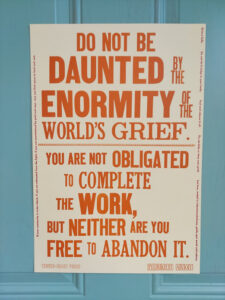
The day after the shooting, more than 500 people packed the sanctuary as we bravely gathered just blocks from the site of the crime scene. One of the clergy shared a reading from the Pirkei Avot, “Do not be daunted by the enormity of the world’s grief. Do justly now. Love mercy now. Walk humbly now. You are not obligated to complete the work but neither are you free to abandon it.” This ancient wisdom reached through, reminding each of us gathered: there was no way to prepare for this tragedy, but there is a way to repair. It will be slow. It will take all of us. It will demand our attention. It will require our presence. And that will be enough.
___________________________________________________________________
 Maddie Gold
Maddie Gold is interested in theology that changes people’s lived experiences. After receiving her MDiv from Princeton Theological Seminary, Maddie took a detour from academic life to work in parish ministry for three and a half years on the North Shore of Chicago. Maddie is now pursuing a PhD at Loyola University Chicago’s Integrative Studies in Ethics and Theology program and seeking ordination in the Episcopal Diocese of Chicago.