
By Luke Baumel
June 5, 2024
Listen to this post.
“You decided to spend your spring break in the cold, rainy, small village of Taizé, France? I thought college students in the United States were supposed to be somewhere warm like Florida?”
Brother Paolo’s joke offered something for my whole student group to consider: Why were we here? What drew us somewhere so uncomfortable and yet comfortable?
The Taizé Community, situated in Taizé, Saône-et-Loire, Burgundy, France, is an ecumenical Christian monastic community. Established in 1940 by Brother Roger Schütz, a Reformed Protestant, the community is comprised of over one hundred brothers who hail from Catholic and Protestant backgrounds, representing approximately 30 nations worldwide. It’s principles and practices are delineated in the Rule of Taizé, which was authored by Brother Roger and initially released in French in 1954. Taizé prayer is centered around reflection and song with repeated lyrics that lead to deep contemplation. As I immersed myself in the rhythm of prayer and song alongside fellow pilgrims from around the globe, I discovered a profound sense of belonging.
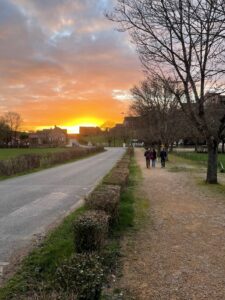
The road up to the Taizé community.
My introduction to Taizé-style prayer came unexpectedly during my sophomore year at Loyola University Chicago. Little did I know then that it would become a cornerstone of my spiritual journey. The simplicity of repetitive lyrics guiding us into deep reflection struck a chord within me.
Stepping into Taizé, I found a sanctuary of renewal. It was a place where people from all walks of life converged, seeking solace and guidance. While my own time in the Taizé didn’t involve drastic life changes, Taizé prayer marked a step in a significant turning point in my faith.
One hymn, in particular, encapsulated my experience: “Wait for the Lord, whose day is near. / Wait for the Lord, keep watch, take heart.” Spring break was during Lent, a season of waiting and reflection. I found myself contemplating not just Christ’s imminent arrival but also my own path ahead.
The past year had been a journey of faith and learning to trust in God’s guidance. Amidst the challenges of leadership and personal trials, I found solace in daily prayer via the Ignatian Examen and scripture through Father Mike Scmidt’s Bible in a Year podcast. Embracing a deeper trust in Christ led me to unexpected opportunities, including the Spiritual Exercises in the Everyday Life program and weekly Taizé prayer in my campus chapel. Through this, I was also able to discover the way in which I felt God was calling me to lead—by showing deep compassion for others in the way Christ did.
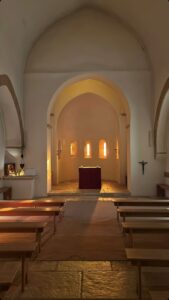
The village church in the town of Taizé.
The prayer was beautiful each and every day. Never in my life have I been in a place with hundreds (sometimes thousands) of people so united in song, prayer, and reflection. Everyone sings out so loudly and proudly in praise of the Lord. Everyone—Catholics, Protestants, and non-religious people alike—is there praying for something or someone and doing so with their whole heart, soul, and mind. At times, I would pause my own singing to focus and dive deeper into my prayer, and it would send chills down my spine to hear the beautiful music continue and support my own personal prayer. This type of prayer created close connections with those around me. Not only is everything at Taizé done in community from meals to cleaning, but the opportunity to pray together and support each other through prayer develops connections at an accelerated pace.
Daily Bible study and small groups also helped create community. All pilgrims are invited to take part in a simple Bible study and small group after breakfast each morning, regardless of their religious background or affiliation. My small group consisted of a young Christian Frenchman, one other person from a different university in the United States, and five German people who all self-identified as non-religious. I was tasked with trying to facilitate a Bible-based discussion with a group consisting of a majority that do not align themselves with religion. I was excited and yet a bit scared. Was this the opportunity I had been waiting for from God? How would I approach it?
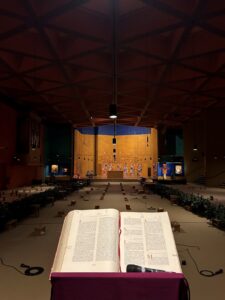
The chapel in the Taizé community. During prayer three times per day, the center aisle is filled with the brothers of Taizé, and the outside aisle is filled with pilgrims, volunteers, and members of the community.
Our first small group time began with introductions and then quickly transitioned to the other young people asking question after question about what faith was to me and why I am faithful. Their curiosity was so beautiful, and they genuinely were listening and trying to understand. Their hearts were open to God in a way that I had not really seen before. They deeply cared about me and why I love and trust in Christ the way I do. We quickly realized that with such a diverse group we learned so much more about God through each other than we would have by trying to dive deeply into the biblical text. Each session was spent choosing the main lesson or two from the biblical story and asking intentional questions about each other’s lives relating to those themes.
By the end of the week, our small group had become a tight-knit community that was united by our shared experiences and a newfound understanding of faith. And even now, we continue to stay in touch, sharing our journeys and supporting one another from across the world.

The sunrise before morning prayer.
These experiences taught me to always seek God in all things and all people. Through intentional conversations and deep connections, I’ve discovered that God is present in the most unexpected places, ready to guide us and fill our lives with joy and hope.
Reflecting on my time in Taizé, I’m reminded of one simple sung truth: “Jésus, ma joie, mon espérance et ma vie,” which translates to “Jesus, my joy, my hope, and my life.” In Jesus, I’ve found joy, hope, and purpose. Trusting in him has not only brought me closer to God but also enriched my relationships with others.
While Taizé may not have been the typical spring break destination, it was exactly where I needed to be—a place of spiritual growth, connection, and unwavering trust in Christ. As I look back on my time in Taizé and the growth I’ve experienced over this past year, I’m filled with gratitude for the journey and the people who walked alongside me. In trusting more deeply in Christ, I’ve found not just answers but a community of love and support that transcends borders and beliefs.
___________________________________________________________________
 Luke Baumel
Luke is a May 2024 graduate of Loyola University Chicago. He studied cognitive/behavioral neuroscience and psychology with aspirations of being a physician. He is taking part in a summer teaching fellowship in summer 2024 and is excited to explore his deep passion for teaching and learning through teaching. Luke has been a cantor and extraordinary minister at his university chapel as well as his home parish. While at Loyola, Luke was involved in leadership in campus ministry in a variety of ways from leading retreats to representing his university at the United States Conference of Catholic Bishops (USCCB) Alive in Christ in June 2022. Luke is incredibly grateful for his family and friends who have supported him in his Christian leadership.